
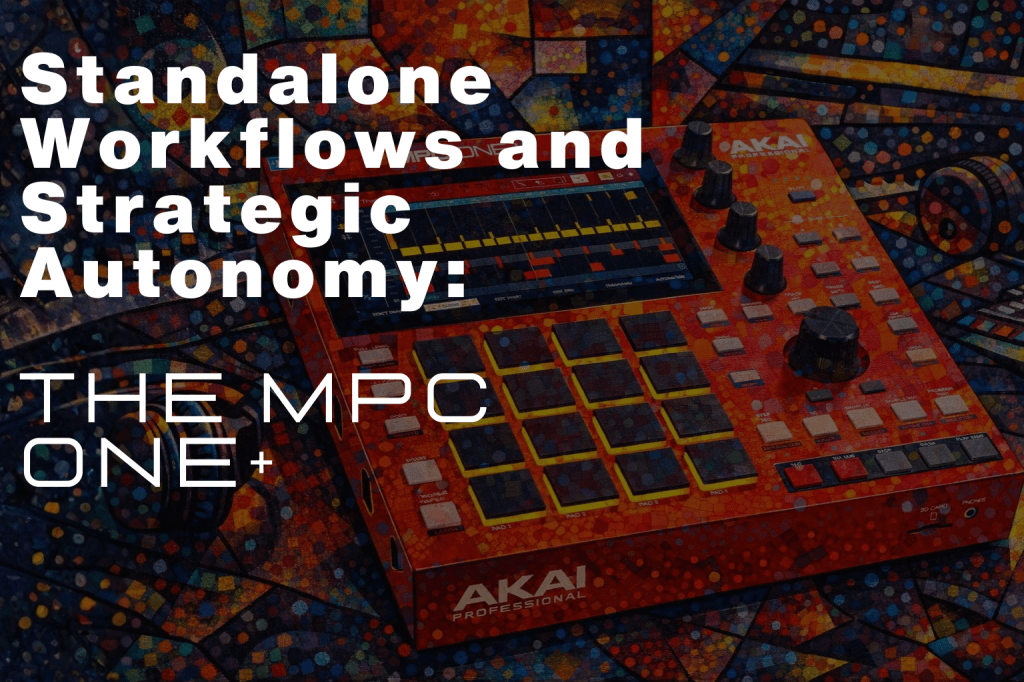
The creative economy rewards velocity, clarity, and control, and in today’s hyper-distributed content landscape, the creator who can move from ideation to output with the least friction consistently outperforms. The Akai MPC One+ sits squarely at the center of that reality. Describing it as a beatmaker undersells what it actually represents. The unit behaves more like an integrated command node for musicians, producers, loop-based performers, and hybrid creators who need to transition from creative impulse to tangible artifact with minimal latency and minimal dependency on broader computing infrastructure. The result is a device that effectively collapses inspiration, production, and performance into a tight operational loop, which is invaluable for anyone navigating modern producer workflows where time, focus, and attention are scarce resources.
One of the clearest differentiators of the MPC One+ is what happens when you remove the computer from the critical path. Traditional DAW workflows rely on a stack of variables that burden the creative pipeline: operating systems, background processes, software updates, audio drivers, notification layers, system audio settings, windows, mouse navigation, and general digital overhead. The MPC One+ sidesteps that entire stack by default. With features like 128-track sequencing, onboard synth engines, real-time time-stretching, and integrated sampling, the user can build full productions without touching a laptop. For a creator who values uninterrupted flow, the operational advantage is significant. Every step removed from the path between concept and execution compounds over time, especially under improvisational or performance-based creation models where overthinking is the enemy and momentum is king.
This translates into concrete benefits for loop-driven workflows. Creators who rely on spontaneous execution appreciate that the MPC One+ maintains a low cognitive load. Menu depth is minimal for critical functions. Signal pathways are defined rather than inferred. The device is built to operate offline, fully self-contained, with no hidden dependency chain that might fracture in the middle of a session or a live set. For a musician who also has to serve as their own engineer, producer, mixer, and sometimes broadcaster, that reduction in surface area feels less like convenience and more like strategic enablement. It respects the creative mind and its limitations without compromising capability or sound quality.
Connectivity extends this strategic posture. The MPC One+ incorporates Wi-Fi, Ableton Link, class-compliant USB, and classic MIDI I/O in a way that supports scale rather than complexity. When a unit integrates cleanly across hybrid ecosystems without becoming a network appliance, it empowers creators to architect their rigs according to ambition and not according to device limitations. The practical implication is that the One+ becomes a compliant node across multiple operational scenarios: standalone composition, hybrid DAW control, or performance routing with loop stations, interfaces, and stage gear. A musician can compose a full track without touching a computer, synchronize it to Ableton for timeline control when needed, and route it to outboard hardware for live looping, sampling, or multi-device performance.
This modularity matters in a world where content pipelines span multiple domains. A single producer might record an idea, perform it live on Twitch, capture stems for distribution, clip highlights for short-form platforms, print audio for mixing, and archive MIDI for future arrangement—all within the same week. The MPC One+ does not force the creator to maintain multiple redundant systems or workflows. It becomes the central nervous system that supports each branch of modern production without demanding constant reconfiguration or hardware swaps. That kind of design eliminates friction and protects momentum, which in turn protects output velocity, and that velocity is increasingly tied to both audience growth and platform relevance.
Sound generation and sampling are where the MPC lineage historically differentiates, and the One+ continues that legacy. The hardware includes AIR instruments, sample packs, plugin effects, and synthesis engines capable of producing competitive, modern results. But the true differentiator is not just what the device sounds like—it is how quickly it enables sound to become structure. Real-time sampling and editing matter because they remove bottlenecks associated with round-tripping into DAWs. A creator can capture external instruments through line inputs, sample vinyl directly, slice audio across pads with tactile control, assign drum programs with signal chain effects, time-stretch vocals without rendering, and pitch samples without committing to destructive edits. The system encourages experimentation because the cost of experimentation is low. When the cost of trying something is reduced, the volume of attempts increases, and that shift alone accelerates creative discovery and unique signature development.
From a user experience standpoint, the device shows a strong understanding of how creators actually think and work. The seven-inch touchscreen offers enough visual real estate to navigate waveforms, envelopes, routing, and arrangement without becoming a distraction. The velocity-sensitive pads provide tactile articulation that software-only environments cannot replicate without additional controllers. Dedicated function buttons minimize context switching, which is critical for maintaining flow state. Anyone dealing with ADHD or high cognitive load understands how disruptive a single distraction can be. The MPC One+ protects against that by offering a finite operational surface. Instead of navigating between dozens of windows, notifications, browser tabs, and system dialogs, the user engages with a contained interface designed specifically for music. This has a human impact beyond efficiency. It allows the musician to experience music again as a physical and emotional craft rather than just digital manipulation.
This human-centric framing ties into a broader trend occurring in the music technology space. Studios are decentralizing. Remote collaboration is normalized. Live streaming is mainstream. Hardware-software hybrid rigs have moved from niche to standard. Artists are increasingly expected to ideate, produce, perform, distribute, and engage their audience from the same workstation. The MPC One+ aligns with that reality. It grants autonomy in a world where autonomy creates leverage. When a creator does not have to wait for a system to load, for plugins to scan, for a DAW to update, for an interface to handshake, or
 gdotbennettmusic.com